For Healthcare / Primary Care
You can't treat what you can't see.
Doctors and care teams work inside the EHR. What happens at home, like a fall, a missed pill or blood pressure creeping up, rarely makes it there.

What we heard
Health system leaders, remote care operators and federal and state program leaders told us where the gap is.9
If it's not in the EHR, it doesn't exist.
There's great technology in homes producing useful data. But clinicians are too busy to go looking for it.1
Patients don't tell you everything.
Less than half of older people who fall tell their doctor.2
There aren't enough clinicians.
The number of Americans 65 and older is projected to reach 73.1 million by 2030.3 The U.S. faces a shortage of up to 86,000 physicians by 2036.4 In rural areas, distance makes it worse. A provider can only reach so many patients in a day.5
The work at home is hard to staff.
Medicare already pays for care at home, like remote patient monitoring. Most practices don't have the staff to do it.1
Point tools don't add up.
On the Rural Health Transformation panel, the CMS view was that success is not a set of point tools patched together. It has to be an approach that scales across states.6
Rural is about access.
On the same panel, rural was defined by access to care, not only by geography. Anyone who can't easily reach care has the same need.6
How NestCara helps
NestCara connects healthcare to health at home. Once home data reaches the record, doctors, care teams and health plans can act on it.
- Home data, in the EHRNestCara pulls in data from the Nest HD, connected health devices and partner devices. AI turns it into actionable insights, built to be delivered into the EHR. Epic and Cerner come first.
- Remote patient monitoring that runs smoothlyA connected blood pressure cuff, scale and blood oxygen meter send readings automatically through the Nest HD. Your clinical team reviews them and talks with the patient. NestCara handles the device, data and setup work.
- Telemedicine on the TVVideo visits on the screen people already know. No app to download and nothing new to learn.
- Chronic and behavioral careBuilt to support remote patient monitoring (RPM), remote therapeutic monitoring (RTM), chronic care management (CCM) and behavioral health integration (BHI).
- Consent comes firstBefore anything is shared, NestCara checks what the person agreed to. Each person sees only what they are allowed to see. Only the legal representative can sign or change consent. If the person can decide for herself, she is her own legal representative and can change consent on the TV.

What it means for your patients and your team
- Better decisions with a fuller picture of the patient.
- Earlier warning, so problems can be caught sooner.
- Reach more patients without adding staff.
- Care at home that shows up in the record.
- Better outcomes, quality of life and longevity for patients, with lower costs as the goal.
The Rural Health Transformation Program
The Rural Health Transformation Program puts $50 billion into the 50 states over 5 years, $10 billion each year from FY2026 through FY2030.7 The money comes with KPIs and clawbacks.
CMS asks each state to track at least 4 measurable metrics for each initiative and to report every quarter and every year. If a state doesn't show progress, CMS can hold back, reduce or take back its money.8
What the 50 states told CMS they need5
Where NestCara fits the KPIs states report8
Access
Telemedicine visits on the Nest HD bring care into the home.
Quality and health outcomes
Readings like blood pressure, weight and blood oxygen go to the care team and, as the connection is built, into the EHR.
Workforce
One provider can reach more homes without the drive.
Technology use
The Nest HD gives the home telehealth access. NestCara is built to put the data into the EHR.
Program implementation
NestCara counts homes deployed, visits and readings for audit-ready reports.
Financial
Indirect. NestCara does not claim this yet.
How we talk about outcomes
RHTP KPIs are new, and each state sets its own. No vendor has mature evidence yet, and NestCara doesn't claim any. NestCara is built to deploy, measure, report and improve the KPIs you define in your contracts, from the first day.1
Only the 50 states receive RHTP awards. Other groups take part through the state, by subaward or partnership.7,1 NestCara works with each state's prime contractors and programs.
Where you fit in the NestCara ecosystem
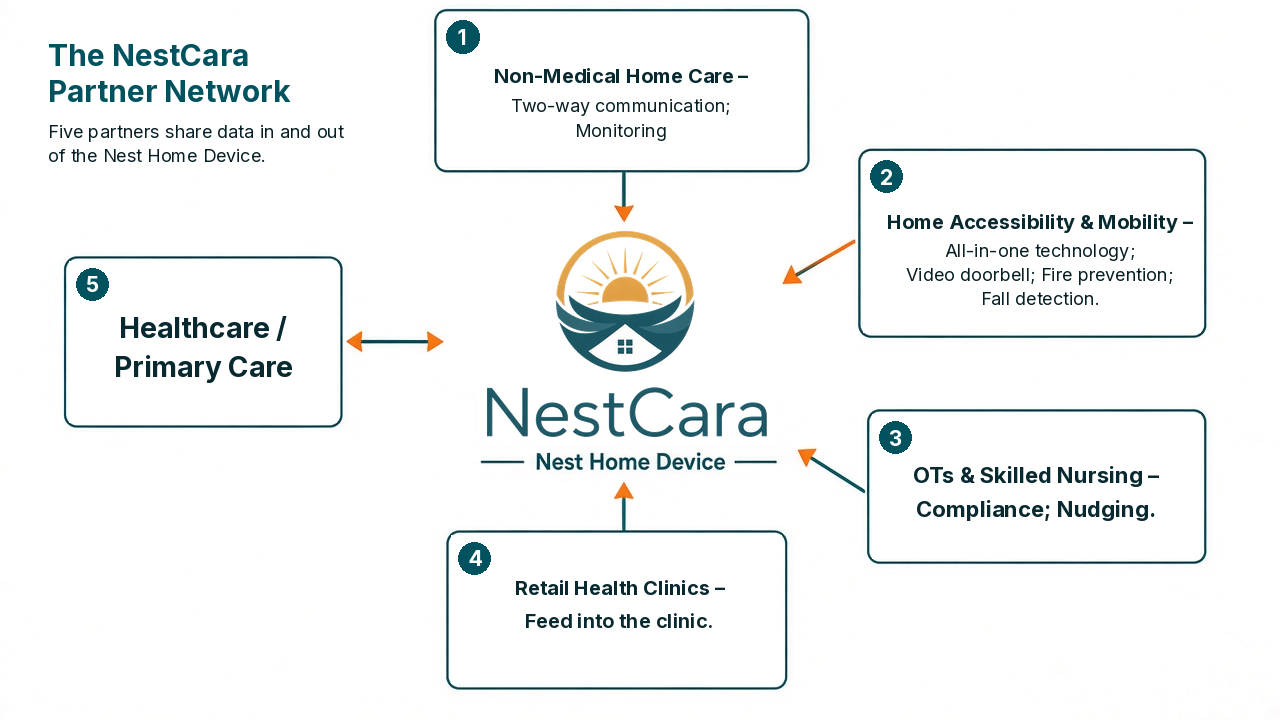
Healthcare / Primary Care sits at the end of the NestCara Partner Network, and data flows both ways. By the time NestCara reaches a practice, the home care, home accessibility and mobility, therapy and clinic partners before it will have built data that already speaks healthcare.
Connect your care team to the home
NestCara is not on the market yet. Health systems, practices and RHTP directors who talk with us now help shape how it reaches the EHR.
Sources
- 1. Long Haven Partners, research and channel findings summarized in the Master Business Plan, October 2026.
- 2. CDC, Facts About Older Adult Falls (reviewed September 8, 2026): more than 1 in 4 older people fall each year, but less than half tell their doctor; falling once doubles the chance of falling again; about 4.5 million emergency department visits and 1.4 million hospitalizations each year; home hazards are a risk factor. https://www.cdc.gov/falls/data-research/facts-stats/index.html
- 3. U.S. Census Bureau, Demographic Turning Points for the United States: Population Projections for 2020 to 2060 (P25-1144), Figure 1: 73.1 million people age 65 and older in 2030; 1 in 5 Americans 65 or older by 2030. https://www.census.gov/content/dam/Census/library/publications/2020/demo/p25-1144.pdf
- 4. AAMC, press release, March 21, 2024: the United States will face a physician shortage of up to 86,000 physicians by 2036. https://www.aamc.org/news/press-releases/new-aamc-report-shows-continuing-projected-physician-shortage
- 5. Long Haven Partners review of all 50 state RHTP plans, filings, webinars and budget documents, May 2026.
- 6. Long Haven Partners notes from the Nashville Health Care Council D.C. Delegation, Rural Health Transformation panel, April 28, 2026, as cited in the Master Business Plan, October 2026.
- 7. CMS, Rural Health Transformation (RHT) Program overview: $50 billion to the states over 5 fiscal years, $10 billion each year, FY2026 to FY2030; only the 50 states can receive awards. https://www.cms.gov/priorities/rural-health-transformation-rht-program/overview
- 8. CMS, RHT Program Notice of Funding Opportunity CMS-RHT-26-001 (metrics and evaluation plan), RHT Program FAQ III.18 and IV.4, and RHT Program Terms and Conditions, Budget Period 1, as summarized in the Long Haven Partners Master Business Plan, October 2026. Documents are listed on the CMS program page. https://www.cms.gov/priorities/rural-health-transformation-rht-program/overview
- 9. Long Haven Partners, 230+ interviews across manufacturers, healthcare, agencies and all 5 verticals, January to September 2026. Findings are paraphrased; no one is quoted by name.
Statistics come only from the sources above. Interview findings are paraphrased and do not name the people we spoke with.